Yoga & Mindful Practice
How to Choose a Yoga Bolster for Restorative Practice
A yoga bolster can turn a supported pose from a balancing act into a place to pause. The right shape, firmness, and fabric help you settle comfortably, breathe with ease, and make the most of restorative practice—at home or in a studio.
Restorative yoga is less about reaching a dramatic shape and more about finding a position you can inhabit without strain. A bolster can help make that possible. Placed beneath the chest, back, hips, or knees, it offers steady elevation and distributes support so your muscles do not have to work as hard to hold you there.
That support is not one-size-fits-all. A bolster that feels wonderfully firm in a reclined pose may feel too tall beneath the knees; a compact shape that works well in a small home practice area may not provide enough length for a full-body recline. Choosing thoughtfully means considering what you want to support, how much lift feels comfortable, and whether the prop is practical to use and care for.
There is no single “perfect” bolster for every body or sequence. The most useful one is stable enough to feel dependable, comfortable enough to invite stillness, and suited to the poses you actually practice. These details can help you make a confident choice.
What a yoga bolster does in restorative practice
A yoga bolster is a supportive cushion designed to help the body rest in a particular position. Unlike a soft bed pillow, which tends to compress unevenly, a practice bolster is generally made to maintain its shape under the weight of the body. That stability matters when you are settling into a pose for several minutes.
In a supported chest opener, for instance, the bolster may run lengthwise along the spine to gently elevate the upper body. Beneath the knees, it can ease the feeling of tension through the lower back for some practitioners. Under the hips, it may create a small change in elevation during a reclined position. The goal is not to force a deeper stretch or make a pose look a certain way. It is to make the position feel sustainable and free of unnecessary effort.
Small adjustments can make a meaningful difference. A folded blanket at the bolster’s end, a block beneath one side, or a different angle may change the support enough to make the pose feel more settled. Props are tools for adapting practice—not tests of flexibility.
Start with the poses you want to support
Before comparing fabrics or dimensions, picture how you expect to use your bolster. Think about the poses you return to, the parts of your body that benefit from extra support, and whether you want one versatile prop or a specialized shape for a particular position.
- For reclined support: Consider whether the bolster is long and stable enough to support your torso or back without sliding or collapsing.
- For knee or ankle comfort: A supportive bolster can provide elevation, but a lower, softer arrangement may be more comfortable than a tall, firm one.
- For seated practice: A bolster may provide a perch or help support the body in a reclined or forward-leaning position. A dedicated meditation cushion may be more suitable for regular upright sitting.
- For travel or small spaces: Check the bolster’s size, weight, and storage requirements before choosing a full-length model.
Also consider the surface where you practice. A bolster on a smooth floor may move more easily than one on a grippy yoga mat. If you tend to change positions often, a manageable size and a cover that is easy to grasp can make adjustments less disruptive.
Shape: round, rectangular, or compact?
Bolster shape influences how the prop meets your body. Round and rectangular bolsters are common, and each offers a distinct feel. Neither is automatically better; the best shape depends on the kind of support you prefer and the poses you plan to explore.
Round bolsters
A round bolster provides a curved surface and can feel comfortable beneath the spine or torso in reclined shapes. Its rounded profile may create a more noticeable lift than a flatter prop, depending on the bolster’s diameter and firmness. If you are new to restorative yoga or sensitive to pronounced elevation, test the height carefully and add blankets for a gentler transition if needed.
Rectangular bolsters
A rectangular bolster offers a broad, flatter surface. Some practitioners like that feeling of a stable platform beneath the back, chest, or legs. Its edges can make it easier to position consistently, while the overall height and firmness determine how much elevation it provides. Look at the listed dimensions rather than relying on the shape name alone: rectangular bolsters can still vary considerably.
Shorter or compact designs
A compact bolster can be easier to store and reposition, particularly in a shared room or a small practice area. It may work well for targeted support, but could be too short for poses that call for support along a longer portion of the body. Consider the length of your torso and the placement you have in mind before deciding that a smaller prop will meet every need.
If you have the opportunity to try a bolster in person, lie back on it and notice whether the support feels even. If you are buying online, compare the measurements with a cushion or rolled blanket you already own. This simple comparison can help you visualize the prop’s scale at home.
Firmness: supportive should not mean uncomfortable
Firmness is one of the most important considerations because it affects both stability and comfort. A very soft bolster may feel inviting at first, but if it compresses substantially under your weight, your body may sink farther than intended. A very firm bolster can provide dependable lift, yet feel too intense under sensitive areas or in a position that requires a gradual opening.
Look for a balance: the bolster should hold its shape enough to support you, while still feeling comfortable where your body makes contact. Think of the intended result as steady and yielding, rather than hard or overly plush. If you are unsure, a moderately firm prop is often a flexible starting point for a range of supported poses.
Remember that your sense of firmness depends on more than the filling. The bolster’s height, width, fabric, and placement all influence how it feels. A firm prop placed under the entire back distributes pressure differently from the same prop positioned beneath a small area. You can also modify support with a folded blanket, especially while you are learning what feels appropriate.
During practice, check in with your body rather than trying to endure a position. The support should not create sharp discomfort, numbness, tingling, or pressure that increases over time. If a pose feels wrong, come out slowly and adjust the arrangement. People with injuries, persistent pain, pregnancy-related concerns, or other health considerations may wish to ask a qualified healthcare professional or appropriately trained yoga instructor about suitable modifications.
Materials and fill: feel, weight, and upkeep
The filling helps determine how a bolster responds to pressure. Cotton batting and kapok, for example, are used in foam-free designs. Their feel and density depend on the construction, so it is useful to read the product details and look for descriptions of how firmly the bolster holds its shape. Covers made from cotton canvas can offer a durable outer layer, while a removable cover can make routine cleaning more convenient.
Natural materials may appeal to people who prefer a foam-free prop or want to understand what is inside their yoga accessories. Still, “natural” does not tell you everything about performance. Consider the bolster’s support, construction, weight, and care instructions alongside the material description. A comfortable prop that is difficult to clean or too heavy to move may be less practical for your routine.
One example is the foam-free yoga bolster, made with cotton batting and kapok. Its removable cotton-canvas cover is designed to simplify cleaning, and the listed dimensions are 24 inches long by 8 inches high. Those details may help you judge whether its compact form and construction suit your intended poses and storage space.
Ask whether the cover can be removed, how it should be washed, and whether the filling itself requires special care. Regularly airing a bolster and following the maker’s washing instructions can help keep it fresh. Avoid assuming that the entire prop is machine washable just because its cover is: care requirements differ by design.
Dimensions and stability matter more than labels
Product descriptions such as “standard,” “large,” or “restorative” can be helpful, but measurements offer a clearer picture. Compare length, width, and height with your body and the poses you expect to practice. A broad, tall bolster can feel reassuring under the chest, while a lower profile may be easier to approach for a gentle supported position.
Stability is equally important. When you place the bolster on the floor, it should stay put as you ease your weight onto it. Check whether the filling shifts, whether the seams look sturdy, and whether the cover has a texture that grips the floor or mat. A handle can also make it easier to carry a bolster from storage to your practice space, although not every design includes one.
At home, you can make a quick scale check without buying anything: measure the intended area of your body and compare it with the listed dimensions. You can also arrange folded blankets to approximate the height. This will not reproduce the feel of a purpose-made bolster, but it can help reveal whether the size is likely to suit your room and practice.
A simple way to test a bolster in a supported pose
If you already have access to a bolster, begin with a straightforward position and take time to adjust. The following steps are general comfort checks, not a prescribed sequence or medical treatment.
- Place the bolster where you intend to use it, making sure it sits securely on the floor or mat.
- Lower yourself into the position gradually, using your hands for support rather than dropping your full weight onto the prop.
- Notice whether your body feels evenly supported. Look for unnecessary pressure, strain, or a sense that you need to hold yourself up.
- Adjust the bolster’s angle or add a folded blanket if you need less height or a softer transition.
- Stay only as long as the position remains comfortable, and exit slowly if you feel discomfort or unusual sensations.
The right arrangement may feel quiet rather than dramatic. You should be able to let your weight rest on the support without forcing a stretch. If breathing feels restricted, or you find yourself bracing to stay in place, the position or prop may need adjustment.
When a meditation cushion or zabuton may be a better fit
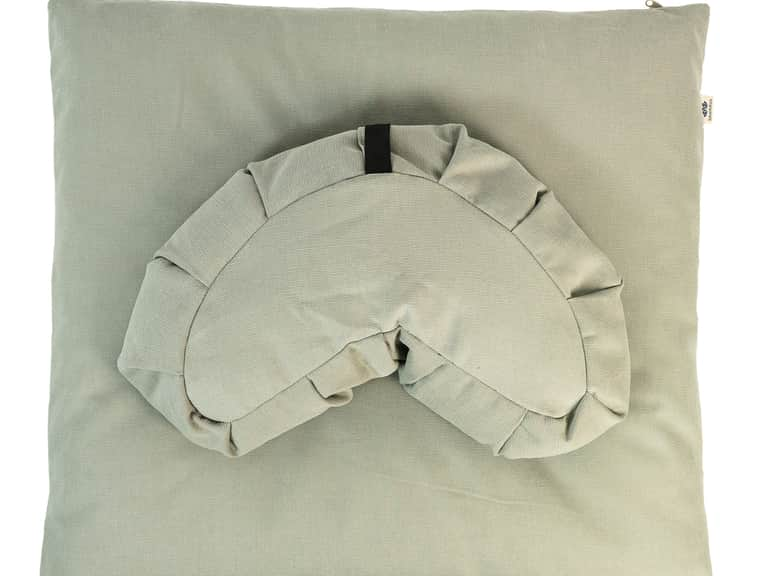
Bolsters are versatile, but they are not the only yoga props designed for comfort. If your main goal is to sit upright for meditation, a cushion made for seated practice can offer a more targeted foundation. A zabuton is a floor cushion designed to sit beneath a meditation cushion, softening the contact between the floor and the ankles, feet, or knees.
A meditation arrangement may include both pieces. The crescent cushion in the Crescent Meditation Set is filled with USA-grown organic buckwheat hulls, while its zabuton uses natural cotton batting. The set is wrapped in cotton canvas and provides a dedicated foundation for seated practice. It is a different kind of support from a yoga bolster, so choose based on how you expect to use the prop most often.
If you practice both restorative poses and seated meditation, consider your available space and how frequently each activity fits into your routine. One well-chosen bolster and a folded blanket may be enough for varied supported positions; a dedicated cushion-and-zabuton setup may make more sense if floor sitting is a regular part of your day.
Common shopping mistakes to avoid
- Choosing by appearance alone. A color or fabric may catch your eye, but shape, measurements, support, and care instructions are more likely to determine whether the bolster works for your practice.
- Assuming firmer is always better. Stability matters, but an overly firm or tall prop can create unwanted pressure. Match support to the position and your comfort.
- Ignoring storage and weight. A bolster that is awkward to carry or store may not be easy to use consistently. Measure your storage space before ordering.
- Expecting a prop to fix pain. A bolster can make a position more comfortable for some people, but it is not a substitute for individualized medical advice or treatment.
- Overlooking cleaning instructions. Covers and fillings may require different care. Check the details before washing to avoid damaging the material or construction.
A practical checklist before you buy
Use this short checklist to compare options without getting lost in product labels:
- Which poses do I want to support most often?
- Would a round, rectangular, or compact shape work best for those positions?
- Are the listed dimensions suitable for my body and practice space?
- Does the filling seem stable enough to support me without feeling uncomfortably hard?
- Can I remove and clean the cover, and do I understand the care instructions?
- Is the bolster easy to move and store where I practice?
- Can I adjust the pose with blankets or other props if the support feels too high?
Choose the prop that helps you settle
A yoga bolster is most useful when it meets your practice where it is. Look for a shape that suits your favorite supported poses, a firmness that feels stable without being harsh, and dimensions that work in both your body’s space and your home. A removable cover and clear care instructions can make the prop easier to maintain, while thoughtful materials may help you choose a feel that fits your preferences.
Most of all, treat comfort as the deciding factor. Restorative practice does not require you to force a pose or stay in a position that feels uncomfortable. Start simply, use blankets to fine-tune the height, and make adjustments whenever your body asks for them. With the right support, a bolster can become a quiet invitation to pause—one steady breath at a time.